
One of the things I value most in a professional partner is knowing that they will look beyond the transaction in front of them.
That came through clearly in my conversation with Tony Redondo, founder of Cosmos Currency Exchange. Tony has spent decades in banking and foreign exchange, but what stood out to me wasn’t simply his knowledge of currency markets. It was his belief that financial services should still be personal.
Throughout our conversation, we kept returning to an idea that resonates deeply with me and with the work we do at Forecastle Financial. The earlier the right professional becomes part of the conversation, the more opportunities there are to anticipate problems, consider alternatives, and make life easier for the client.
Foreign exchange can easily be treated as the final step in an international transaction. Tony makes a compelling case for thinking about it much sooner.
Watch the full interview HERE.
– Sara Hobbs, Forecastle Financial
Tony Redondo is the founder of Cosmos Currency Exchange, a UK-based foreign exchange brokerage focused on personalized solutions for individuals and businesses navigating international transactions.
His career in financial services began in banking in 1985 and evolved through property finance, corporate finance, and foreign exchange before he founded Cosmos in 2020.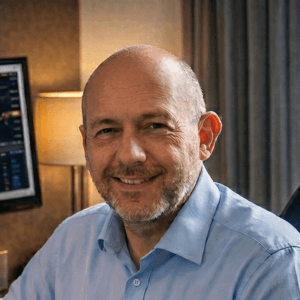
His philosophy is rooted in a lesson he heard repeatedly from his mother, a highly skilled seamstress: “The trouble with one size fits all is it doesn’t fit anybody very well.”
Today, that idea sits at the heart of how Tony approaches currency exchange.
For many of us, foreign exchange feels like a utility.
You need euros, pounds, dollars, or another currency. You check the exchange rate, initiate a transfer, and move on.
For routine transactions, that may be perfectly adequate. But larger or more complicated international transactions can involve much more than converting one currency into another.
The countries involved, where the client resides, how funds need to be received, banking requirements and the timing of the transaction can all matter. Tony’s argument is simple. When the circumstances become more complex, the solution may need to become more personal as well.
That can be particularly important for affluent families whose financial lives increasingly cross borders. Buying or selling property abroad, conducting international business, settling an estate with international assets or beneficiaries, sending a child to an overseas university or making a significant payment abroad can introduce complexities that simply don’t exist in an ordinary domestic transaction.
Tony shared the story of an American client from Arizona who was trying to purchase property in Portugal.
She was a cash buyer and had prepared for the purchase by consolidating the necessary funds in a U.S. checking account. The problem wasn’t having the money. It was getting it to where it needed to go.
According to Tony, the client couldn’t yet establish the Portuguese banking relationship she needed, while her U.S. bank would not release the funds internationally without her appearing in person. The trouble, of course, was that she was already in Portugal.
After two unsuccessful attempts to purchase property, she contacted Tony after hearing him on another podcast.
Tony was able to establish a different route. He onboarded her using her Arizona information and provided access to a U.S. dollar collection account in New York. Her bank could therefore move the dollars domestically. Tony then handled the currency conversion and arranged for the funds to be paid directly to the Portuguese solicitor.
What made the difference wasn’t simply finding a better exchange rate. It was understanding the entire transaction well enough to identify another path.
The relationship didn’t end with the purchase. Tony said the client subsequently purchased another property and later returned to him as she prepared to sell one of her Portuguese properties and repatriate the proceeds to the United States.
This was one of the most important points in our conversation.
As a Personal CFO, I spend a great deal of time looking ahead. What’s coming? Who needs to be involved? What decisions should be made now, before our options become limited?
Tony takes much the same view of foreign exchange.
He encourages wealth managers, family offices, accountants, attorneys, and CFOs to involve a currency specialist earlier rather than later. And the reason isn’t simply to watch for an attractive exchange rate. Planning ahead can affect the options available for moving the money itself.
Tony illustrated the point with the example of a UK client selling property in Spain.
He explained that the client’s options could differ depending on whether the currency relationship was established before or after the property sale was completed. In his example, establishing the relationship while the client still owned the Spanish property could allow the funds to be routed through a euro-denominated account in Brussels rather than sent directly to the UK.
Tony said that under the circumstances he described, this could avoid a percentage-based bank charge that might otherwise apply to the transfer.
The larger lesson extends well beyond that particular scenario: Before a major international financial event occurs, ask what decisions can be made today that might give you more options tomorrow.
Perhaps my favorite story from Tony had nothing to do with winning a client.
An accountant referred him to an American oil and gas company with thousands of employees around the world. The company was experiencing problems involving its international payroll, including delays, exchange rates, and intermediary fees.
On the surface, it sounded like an ideal opportunity for a currency broker.
Tony told them otherwise.
Cosmos is designed around individualized transactions rather than highly automated, high-volume processing. In this case, Tony explained that manually processing thousands of recurring payroll transactions through Cosmos would create inefficiencies for the company.
He recommended a different type of provider, one capable of uploading employee payments in bulk and processing the currency conversions at the same time. Cosmos, he explained, would be better suited to transactions such as funding expansion into a new country, purchasing land or machinery, or establishing a new office.
The prospective client wasn’t expecting that answer. But that’s exactly why it’s such a good example of what trusted advice should look like.
A professional shouldn’t be trying to make every situation fit the service they sell. Sometimes the best advice is recognizing that another solution better serves the client.
Tony’s career has given him an interesting perspective on the evolution of banking.
When he began, banking was intensely personal. Bank managers knew their clients. Over the years, call centers, online banking, automated systems, and financial technology dramatically changed the way financial services were delivered.
Those developments have brought tremendous convenience. But convenience and advice aren’t the same thing.
An app can execute transactions efficiently. An automated platform can make routine transfers remarkably simple.
What technology doesn’t necessarily provide is someone stepping back and asking whether the transaction should be handled differently in the first place.
That distinction is central to why Tony founded Cosmos. His goal wasn’t to replace technology where technology works perfectly well. It was to focus on situations where complexity makes individual attention and professional judgment more valuable.
Our conversation reinforced something I often see working with affluent families: Financial complexity often doesn’t announce itself in advance.
A property purchase, inheritance, business interest, international investment, family member living abroad, overseas education or other life event can suddenly bring banking, tax, legal, investment and administrative considerations together.
No single professional necessarily owns each of those pieces.
That’s why having the right people involved early matters.
You don’t need to become an expert in foreign exchange. You don’t need to anticipate every banking complication that might accompany an international transaction.
But it helps to recognize when a transaction has moved beyond the ordinary and know who to call before important decisions become difficult to unwind.
That was ultimately my biggest takeaway from my conversation with Tony: Complexity is easier to manage when you plan for it instead of reacting to it.
Sometimes the greatest value a specialist provides happens well before the money ever moves.
Tony Redondo is the founder of Cosmos Currency Exchange. During our conversation, Tony directed listeners to the Cosmos Currency Exchange website and noted that he can also be found on LinkedIn. I also encourage readers to subscribe to his blog, which offers thoughtful commentary on foreign exchange and international money movements.
Website: CosmosCurrencyExchange.com https://cosmoscurrencyexchange.com/
LinkedIn: Search for Tony Redondo Tony Redondo ACIB | LinkedIn

"*" indicates required fields